
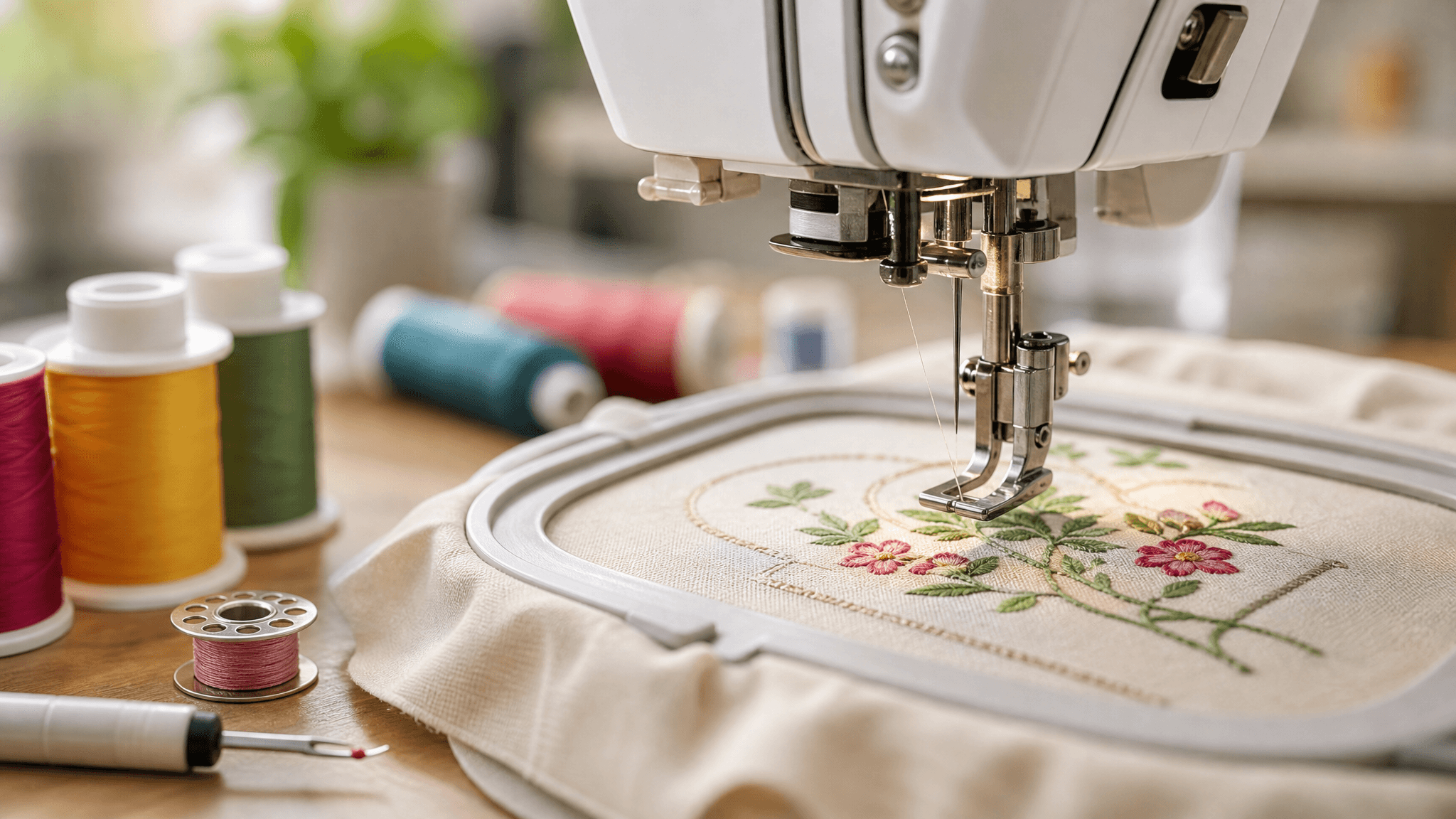
Thread tension problems are the #1 frustration for beginners — and the #1 reason machines get returned or sent for unnecessary repairs. The good news: most tension problems are not machine failures. They are threading errors, wrong needle choices, or stabilizer mismatches. Before you panic or pay for a service call, work through this guide in order.
How to Diagnose a Tension Problem
Before adjusting anything, identify what type of tension problem you actually have. Stitch a test design on scrap fabric and look at the result:
| What You See | What It Means | Direction to Adjust |
|---|---|---|
| Bobbin thread showing on top of the design | Upper tension too tight, OR bobbin tension too loose | Decrease upper tension first; adjust bobbin only as last resort |
| Upper thread loops or nests under fabric | Upper tension too loose, OR threaded with foot down | Rethread with foot UP; increase upper tension slightly |
| Puckering around the design | Tension too tight OR inadequate stabilizer | Decrease upper tension slightly; upgrade stabilizer |
| Thread keeps breaking mid-design | Tension too tight, needle burr, or thread quality issue | Check needle first, then reduce tension, then try better thread |
| Visible “railroad tracks” or gaps between stitches | Tension too loose — stitches are not pulling together | Increase upper tension in small increments |
Step 1: Rethread First — Always
The single most common tension problem is not a tension problem at all. It is incorrect threading. Before touching your tension dial:
- Raise the presser foot (this opens the tension discs so the thread seats correctly between them)
- Remove the upper thread completely
- Remove the bobbin and reinsert it in the correct direction
- Rethread from scratch, making sure the thread passes through EVERY guide, the tension discs, and the take-up lever
- Lower the presser foot and pull gently on the thread — you should feel consistent resistance
If you thread with the presser foot DOWN, the thread sits on TOP of the tension discs instead of BETWEEN them. This creates zero upper tension, causing massive nesting on the first stitch. Every time. Thread with the foot UP, then put it down after threading.
Step 2: Check the Needle Before the Tension Dial
A dull, bent, or wrong-sized needle is the second most common cause of what looks like a tension problem. Before adjusting tension:
- Replace the needle with a fresh embroidery needle (75/11 or 80/12 for standard 40wt thread)
- For metallic thread, use a 90/14 metallic needle with a larger eye
- For thick threads or dense designs, size up one step
- Check that the needle is fully inserted — a needle pushed only partway up will hit the bobbin case
If you have not changed your needle in the last 8 hours of stitching, change it now. Do not overthink this — a fresh needle fixes more problems than any tension adjustment.
Step 3: Adjust Upper Tension in Small Increments
After rethreading and changing the needle, if the problem persists, adjust the upper tension. Make changes of 0.5 to 1.0 at a time (on a scale where 4.0 is typical factory default). Test stitch on scrap fabric after each adjustment. It usually takes 2-3 rounds to dial in.
On Brother machines, the tension setting is usually on the front panel or in the settings menu on the LCD. On Janome machines, there is often a physical dial. Increase the number to tighten, decrease to loosen.
Step 4: Bobbin Tension — Last Resort
Factory bobbin tension is set correctly for the vast majority of situations. Adjusting bobbin tension is a last resort and should only be done if you have ruled out threading, needle, and upper tension. To check bobbin tension:
- Hold the bobbin case by the thread and let it dangle
- Give a gentle bounce — the bobbin case should drop 2-3 inches, not slide freely and not stay put
- If it drops like a yo-yo with no resistance, the bobbin tension is too loose
- If it does not move at all, the bobbin tension is too tight
Adjust the small screw on the bobbin case in tiny increments — a quarter-turn or less at a time. Mark the original position with a permanent marker before touching it so you can return to factory setting. If you are not confident doing this, take the bobbin case to a repair shop — it is a $10-15 adjustment.
Step 5: When to Accept It Is the Machine
If you have worked through all four steps above and the problem persists across different thread brands, needle sizes, and stabilizer types, your machine may have a timing issue, a burr on the thread path, or a tension assembly problem. These require professional service. Common signs:
- Thread shreds at the same point on every project regardless of thread brand
- Tension changes randomly mid-design without you touching the dial
- Stitches skip in a regular pattern (every X stitches, consistently)
- The needle consistently hits the bobbin case or needle plate